The Decision That Changed Everything
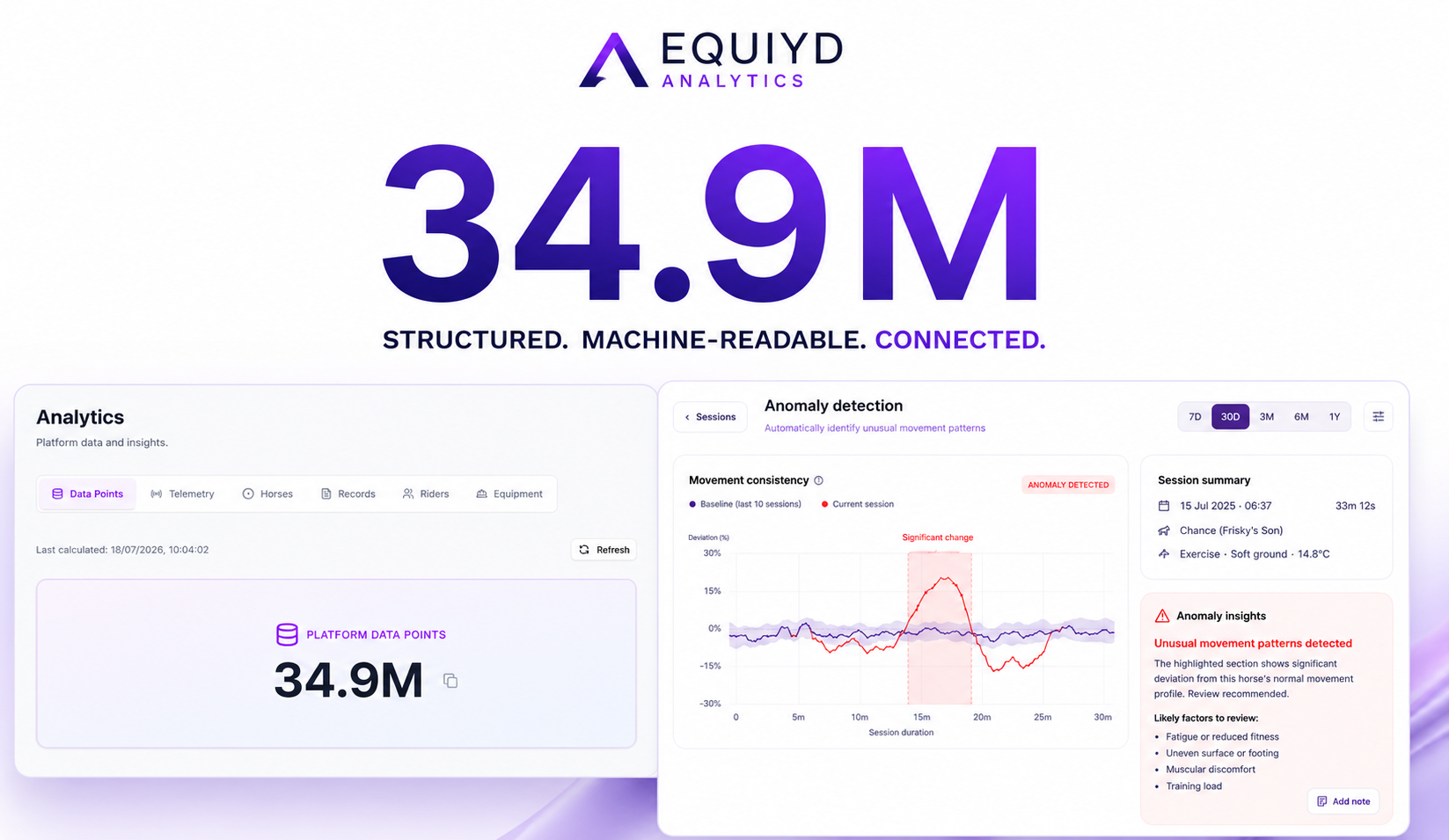
Two days ago, we celebrated reaching 34 million structured, machine-readable data points. As we write this article, we're already approaching 35 million. For many companies, that might simply be another growth milestone. For us, it represents something much bigger. Not because of the number itself. But because of a decision we made on day one.
We started with a simple idea
When Equiyd was founded, we weren't building AI. We weren't building telemetry. We weren't building Computer Vision. We were building a buying, selling and horse management platform. The goal was to help owners manage their horses better and allow important information to stay connected throughout a horse's life. However, our founding team came from healthcare, where we'd seen first-hand the consequences of fragmented information.
Across healthcare, huge amounts of valuable knowledge sit inside disconnected systems and free-text notes. Years later, organisations are investing millions trying to reconnect and structure information that was never designed for machine learning or large-scale analysis.
We decided Equiyd would take a different approach.
One decision changed everything
From day one, every piece of information entered into Equiyd was designed to be structured and machine-readable. Not because we knew exactly what products we'd build in the future. But because we believed that if we ever wanted to understand horses properly, the data had to be usable by both people and machines. That single decision quietly became the foundation for everything that followed.
Then our users changed the direction
This is perhaps the most important part of the story. Equiyd didn't become what it is today because we had a perfect roadmap. It became what it is because our users showed us what they needed. Owners logged care records. Uploaded videos. Recorded training. Tracked routines. Shared information. As the dataset grew, new opportunities emerged. First came our AI Knowledge Base. Then AI Riding Analysis. Then telemetry. Not because we pivoted.Because each new layer became possible through the data that already existed.
Our dataset isn't just large. It's connected
Today, Equiyd manages information across more than 35,000 horses, representing 178 breeds, 36 registered coat colours, and every stage of a horse's life, from foals through to veterans.
But size has never been our goal, context has. Every day, owners record vaccinations, farrier visits, dentistry, physiotherapy, turnout, training, competitions and management routines. They upload videos for AI Riding Analysis, record exercise sessions through telemetry and build a complete picture of their horse over time. Individually, each of those records is useful.
Together, they become something far more powerful.
Context changes everything
One of the biggest lessons we've learnt is that no single piece of information tells the whole story.
A stride on its own tells you very little.
The same stride becomes much more meaningful when you know:
- Who was riding.
- What surface the horse was on.
- Whether it was training or competing.
- The weather conditions.
- The horse's recent workload.
- Its management routine.
- Its care history.
- Previous AI Riding Analyses.
- Previous telemetry sessions.
Every piece of information provides another layer of context. The more complete that picture becomes, the more meaningful the insights become.
Why Computer Vision and telemetry work together
People often ask whether Computer Vision or telemetry is better. The answer is neither. They answer different questions. Computer Vision allows us to objectively analyse movement from video, looking at how the horse moves throughout a ride or competition.
Telemetry adds another layer of objective information by measuring aspects of the session itself, such as speed, gait, cadence, terrain, elevation and other performance metrics. Each technology tells part of the story. When they're combined with the horse's management history, training records and care information, they begin to explain far more than either technology could achieve in isolation. This is why we built an ecosystem rather than individual products.
Real-world learning
Every ride adds another piece to the picture.
Every video helps improve our understanding.
Every telemetry session contributes to recognising what is normal for that individual horse.
Every care record provides context that may help explain changes over time.
This isn't about collecting data for the sake of collecting data.
It's about building a continuously improving understanding of horses, riders and performance through real-world use.
The platform learns because owners continue to use it every day.
Looking ahead
As we approach 35 million structured, machine-readable data points, we're incredibly excited about what comes next.
Not simply because the number continues to grow.
But because every new record strengthens the platform's ability to identify patterns, understand context and support better decision-making.
Our ambition has never been to replace riders, trainers, coaches or veterinarians.
It has always been to give them better information.
To surface patterns that are difficult to see.
To connect information that has traditionally been fragmented.
And to make objective intelligence more accessible across the equestrian industry.
Thirty-five million data points is an important milestone.
But in many ways, it feels like we're only just beginning.
"You can't understand a horse by looking at one moment in time. You understand a horse by connecting thousands of moments throughout its journey."